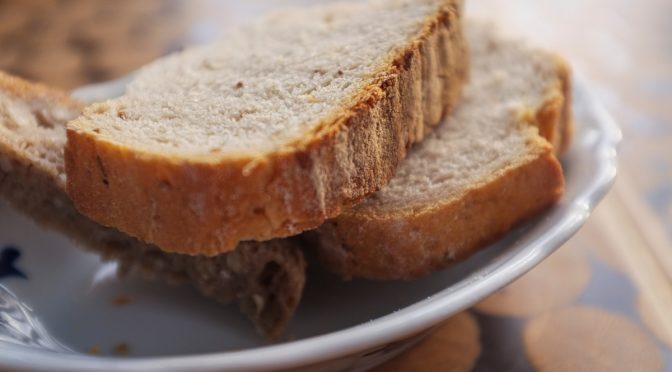
Read John 6:1-14 and 26-41 to start.
Many years ago, when I was in high school and starting university, I worked at a 24 hour gas station. There are lots of stories I could tell about that place, between interesting coworkers, colourful customers, the unbelievable amount of mess that you have to clean up when you break a 1.5L glass bottle of Pepsi, but that’s not what I want to talk about this morning. This gas station was special in that it had a bakery, a real bakery, with dough and ovens and everything. That meant that most every morning, six days a week if I recall correctly, there was a baker who came in and baked bread. When you worked night shift, which ended at 7:00 am, and the baker came in around 6:00, if you were lucky you would enjoy the smell of fresh baked bread at the end of shift.
I don’t know about you, but there are few smells better than the scent of fresh baked bread. Usually we get store-bought bread, but Laura bakes bread occasionally, and the smell just fills the house. It’s so good. A loaf of fresh bread also looks amazing, she brushes a little melted butter on top of the bread while it’s still warm to crisp up the crust and enhance the flavour. It’s rare that a loaf lasts a full 24 hours.
Basically everyone eats bread. I don’t just mean everyone in my household, or everyone here this morning, I mean everyone. Pretty much every culture around the world has some type of bread that is a staple of their diet, or maybe many types of bread. The majority of us eat some sort of bread every single day, whether it’s whole wheat, pita, naan, bagel, dinner roll, sourdough, or a slice of white wonder bread, bread is the most common and universal food in the world. Can you live without bread? Technically, yes, but would you want to? One of my children has issues with gluten intolerance, and he misses bread. When he finds a good loaf of gluten free bread, he is very happy.
Earlier, we had a scripture reading from the first part of John chapter 6. This was the miracle of the feeding of the 5000. What were those people fed? Christ used the food that was on hand, we read at verse 9 that there was a lad who brought a lunch. Maybe he was the only person in all that multitude who brought food, or maybe he was the only one willing to share it, and there is a lesson in that for us, because many were blessed by his willingness to share what he had. That food was five barley loaves and two small fish. Bread and fish. Christ multiplied that a thousandfold, and then multiplied it again, so that all had plenty of bread to eat.
That’s the context of the passage I read to start, it takes place one day after the miracle. Everyone was well aware that Jesus of Nazareth had fed thousands of people with a tiny amount of fish and bread, and they wanted to know more, see more, experience more. And also maybe get a free lunch. After all, someone who can feed a multitude from one bagged lunch is someone worth following.
It quickly becomes obvious that most of those present may not have had the right priorities or the best motives. Christ called the crowd out on this, we read at verse 26 how they were seeking Him not because they watched the miracle, but because they ate of the loaves. He had filled their immediate physical needs, and that was what they cared about.
It’s easy to look at this passage, to look at those people, and to be critical of them and their misplaced priorities, but how often do we behave in much the same manner? We get so consumed with our physical, temporal, earthly wants and needs that we put those to the front of the line, and we don’t make enough time for spiritual matters. And when we do make time for that, it’s often not in a prominent position. Sometimes it’s too little too late.
When I get ready for work in the morning I take a little time after I get dressed but before I eat breakfast to read a daily devotional book, pray and read my Bible. That sounds like a good practice, and I certainly am not advising anyone who reads their Bible in the morning to stop doing that. Quite the opposite, in fact. It’s a highly recommended way to start your day. But there are mornings when I’m watching the clock more than I’m really getting much from scripture, because I want to get to work on time, or maybe even a little early. Or maybe I’m thinking about my upcoming day, rather than focusing on what God might have for me in His word. Or maybe I’m looking for outcomes, rather than seeking out the Spirit’s leading.
That sounds similar to what happened here, the crowd asked Christ in verse 28, what should we do that we can do God’s work? They were interested in following God, in being aligned with His ways, but they didn’t really seem to understand. They wanted to know what they were supposed to do, rather than what they were supposed to be, and certainly not who they were supposed to know. They wanted results, not a relationship.
We see that continue in the next verses, because then the crowd asked for a sign, and they associated the bread that Christ had provided them with the manna that Israel had eaten in the wilderness. It makes sense, and they knew their history. God had provided food by miraculous means before, and now it had happened again. They saw both as bread from heaven, and they were eager to partake. I mean, bread from heaven does sound pretty great.
As mentioned, we all eat bread, we enjoy it, and it forms a key part of our diet. If you eat bread daily, who wouldn’t want bread from heaven?
That seems to be the focus of the crowd, the idea of divine provision of physical bread. They asked about doing the works of God, thinking that if you do what God wants, then He will give you food. And then at verse 34, even after Christ had said that this bread from heaven was a person, they still say “Lord, evermore give us this bread.” They had a clear idea of what they wanted, and it looked a lot like what they had eaten the day before. They liked the idea of a free lunch.
This crowd displayed a mindset that I have talked about before, that you have probably seen before, or maybe experienced this in your own life. It is the vending machine mentality, where if you do the right things, if you say the right prayers, give the right gifts, if you display a sufficient level of holiness, then God will give you whatever it is you want. When we seek to do the right things, but only because we expect to get a reward, then we are doing it not as an act of service, but for selfish reasons.
We do this all the time. Yes, there are things that we do in order to get a reward. I don’t go to the office and work all day unless I’m getting paid, for example. That’s how that works. But Christianity is not a job, where you clock in at a certain time, do the works of God for an allotted time, then clock out some hours later when you’re done and go back to being an unrepentant sinner. Being a Christian is a relationship. To actually be one, not just call yourself one, you need to follow Christ, to follow wherever He leads. It’s not a transactional model, and when we treat it as such, that’s a huge problem.
Transactional behaviour is certainly common, and we probably think of this as normal and expected. When you go to a store, you give them money and you get product, that’s a transaction. That’s how it’s supposed to work. That’s not how relationships are supposed to work, but sometimes that’s how we approach them, and that’s a problem. When we do this with the people around us, the people that we are supposed to care about, then it’s not really a relationship. If I do something for you only because you are going to do something for me, then once that expectation is not met, then why would I keep up my end of the bargain? If someone is treating you like that all the time, then do you want to be their friend?
Unfortunately, we do this with God far too often. How often do we behave like that, we do what we think we should do so that God will bless us, and bless us in a specific way that we are hoping for? And then when He doesn’t conform to our expectations, we become angry or disappointed or disillusioned about Him?
God is not a vending machine. We don’t do the works of God in order to get the bread from heaven. If that’s what we are doing, then we have no idea what the bread of heaven actually is.
The crowd that came to Jesus had no idea, and they were not prepared for the answer. In verse 35, He spelled it out for them. I am the bread of life. This caused confusion, because how can someone be bread? It also caused additional upset, because He said, repeatedly, that He came down from heaven, and they were not ready to hear that. They knew Him as Jesus of Nazareth, the son of the carpenter. They knew his parents, how could he be from heaven?
And then it gets even more difficult, because I’ll read a few verses farther down the chapter. Picking up at (47) Verily, verily, I say unto you, He that believeth on me hath everlasting life. (48) I am that bread of life. (49) Your fathers did eat manna in the wilderness, and are dead. (50) This is the bread which cometh down from heaven, that a man may eat thereof, and not die. (51) I am the living bread which came down from heaven: if any man eat of this bread, he shall live for ever: and the bread that I will give is my flesh, which I will give for the life of the world. (52) The Jews therefore strove among themselves, saying, How can this man give us his flesh to eat?
The back and forth continues in the following verses, with the people becoming increasingly confused and troubled. They were looking for bread to eat, they were concerned about physical needs. Eternal life, that also sounds good, but how are they supposed to get that? When Christ told them that the bread from heaven is His flesh, then that didn’t make any sense at all. Surely he was not talking about cannibalism, I’m sure they thought, but that may have been what this sounded like to them, and it troubled them.
Sometimes what we get from God doesn’t fit our expectations, doesn’t fit with what we think is best, or what we think He would tell us. We like simple and straightforward answers, and things are often not that way. We don’t have the full picture, and so we don’t comprehend. There can be many reasons for this. Maybe it’s because we are short sighted and self absorbed, or maybe it’s because we are not paying attention, or maybe it’s because we simply don’t understand. Even when we sincerely want to seek and to follow, even when we try, sometimes we just don’t get it.
The crowd seeking bread from heaven, they didn’t get it. Instead of getting the free lunch that they had come for, they got a lot more than they could digest. They were troubled before, but Christ continued, and it didn’t get easier.
(53) Then Jesus said unto them, Verily, verily, I say unto you, Except ye eat the flesh of the Son of man, and drink his blood, ye have no life in you. (54) Whoso eateth my flesh, and drinketh my blood, hath eternal life; and I will raise him up at the last day. (55) For my flesh is meat indeed, and my blood is drink indeed. (56) He that eateth my flesh, and drinketh my blood, dwelleth in me, and I in him. (57) As the living Father hath sent me, and I live by the Father: so he that eateth me, even he shall live by me. (58) This is that bread which came down from heaven: not as your fathers did eat manna, and are dead: he that eateth of this bread shall live for ever.
(59) These things said he in the synagogue, as he taught in Capernaum. (60) Many therefore of his disciples, when they had heard this, said, This is an hard saying; who can hear it?
It troubled them so much that, well, I won’t read the rest of the passage, apart from one more verse. (66) From that time many of his disciples went back, and walked no more with him.
John 6:66 is not an especially familiar or popular verse, not one that you see on greeting cards or that you memorize as a child. It is sad verse about a sad result. The easy thing for me to say is that this was probably inevitable with people who were more interested in their bellies than their souls, but I think that oversimplifies things.
This is not something that we should skip over, because while this is a sad verse, it’s also a stark reminder that listening to the words of Jesus and liking what He said is not enough. Being interested in Christ, or even loosely affiliated with Him, that’s not enough. Look at what it says, many of His disciples went back, and no longer walked with Him. These were people who had heard His teachings, some of them perhaps many times, they liked what He had to say, but when it didn’t make sense anymore, when it became difficult, they went their own way.
What was it that they missed? They had come looking for the bread from heaven, and when they were told what that actually was, they did not understand.
Maybe you’re sitting here this morning thinking that you don’t understand, either. Maybe you’re thinking that the crowd that came seeking the bread from heaven and left confused and disillusioned may have had a point. If Christ is the bread of life, the bread from heaven, how are we supposed to eat that bread?
There are some who take this concept far too literally, and who say that when bread and wine are blessed for the communion that it becomes the literal body and blood of Christ. This is not exclusively Catholic, although it certainly is a belief held by them, and there are millions of people who believe this and who regularly partake of communion believing that this is what they are doing.
I don’t believe this is what Christ was talking about at all, though. So what does it mean, then, to eat this bread?
Before I answer, here’s a little background. Before I started preparing this sermon, I had a thought about bread, and that thought expanded and became significant enough to be the core of this entire message. We’ll get to the original thought shortly, but for now, let’s go back to where we started, and consider bread. Actual edible bread, fresh baked or otherwise. The metaphor of bread is a richer comparison than we may realize, and certainly Christ did not choose it by accident.
Bread is as basic and as close to an essential food as we have. We use the term bread as an analogue for food in general, if you say you are breaking bread with someone, that means you are eating with them, regardless of what is actually on the menu. Bread is food, and we need food. We need it every single day. Yes, you can in theory go a day or two without eating, and if you’re in decent health you can actually go several weeks without food, but you will suffer for it.
I couldn’t go several weeks without food, with my diabetes if I go even half a day without eating my sugar levels start getting out of whack and I can feel it. I need to take in nutrients, I need to take in calories, or my body stops working right. I need it every day, I can’t get by on yesterday’s bread. And neither can you.
When the disciples asked Christ how they should pray, He gave them a model prayer. We know this as the Lord’s prayer, and it’s probably familiar to you. It’s not long or complicated. It opens with worship to God and recognition of His place and power, and once that is done, the very first thing we are advised to ask God for ourselves? Our daily bread. Give us this day our daily bread. It’s a continual and needful thing, and we need to partake of it.
In much the same way, Christ sustains us when we partake of Him. We need to read His words, we need to meditate upon them. We need to be in prayer, and we need to do this continually. Some people might tell you that what Christ was teaching in this passage that people need to believe in Him, and that’s all that matters, but that does not fit with the bread metaphor at all. Bread is continual and repeated, you partake daily. So should our fellowship with the Saviour likewise be daily.
Yes, we absolutely need to come to Christ in faith and with a spirit of repentance, we need to turn from our sins and turn to Him, but we need to continue to follow, or we won’t live and thrive and before more like Him. If we don’t feed on Him, on His words, if we don’t do His deeds, if we don’t care for the downtrodden, then we are not eating the bread from heaven. If we don’t call out sin and hypocrisy when we see it, and most of the time that starts right here point at self, in ourselves, in our hearts, then we are not doing the works of God. And this needs to be day by day, we don’t take days off from following Christ any more than we take days off from eating.
Maybe you do observe a fast on occasion, and you don’t eat. I’m not going to do that, of course, not with my diabetes, but maybe you do, and that’s fine. But don’t take a fast from Christ. Thinking that you can get along without Him, or not even consciously doing that, but simply neglecting to read the Bible, to pray, to commune with Him, and you’ll notice the difference. Or maybe you won’t, because you haven’t been doing it so well, and you don’t know what you’re missing. You will notice the improvement if you start.
But there’s more to bread than that, than the daily food. I mentioned about fresh baked bread to start, the smell of it, how wonderful that is, and how good a loaf of bread looks, there’s a certain amount of joy from seeing that, from experiencing the aroma, and when you pick it up and you feel the texture, maybe it’s crisp on the outside, or maybe it’s soft, that’s all great. We can all enjoy that. But bread doesn’t actually do anything for us unless it is broken. You have to break it, slice it, tear it apart, something, if you are going to get any real benefit from bread. It provides no sustenance while the loaf remains intact.
And this was my original thought, that Christ, like a loaf of bread, was broken for us so that we might have life. For thirty three years Jesus of Nazareth lived a perfect life, and for the last three and a half years He had a ministry unlike any that had come before, or has existed since. He taught repentance, forgiveness, faith and love, He did miracles without number, but as wonderful as that all is, it’s like a loaf of bread that you only look at, or smell, or admire from a distance. His perfect life is an amazing and a wonderful thing, but it does not save us.
The night before He was crucified, in the upper room he took bread, and broke it, and shared it with His disciples, saying, take, eat, this is my body. At that moment, did they understand? Did they remember what He had taught in Capernaum the day after feeding the 5000, that He was the bread of life? Did they have even an inkling of what came next? I doubt it very much. But we do.
It was His suffering, His trial, His death on the cross and then ultimately His resurrection, that is what has paid the price for our sin. That is what has opened the door to eternal life for me and for you. If you do not partake of that, if you do not acknowledge His sacrifice as the payment for your sins, then you do not partake of Him. If you see Him as a prophet, a teacher, or a visionary, those do not save you. You need to come to Him as the anointed One, the Christ, the promised Messiah, the Saviour. The one who was broken for you.